Short answer: Every Telegram channel loses members, every day. A steady trickle of leaves is normal, and so is a bigger drop after a burst of growth, a change of topic or a run of heavy posting. What isn't normal is a sudden fall that you can't tie to anything you did, or a slow decline where leaves beat joins month after month. Open your statistics, compare joins with leaves rather than staring at the total, and check which posts and which sources the leavers came from. In most channels I look at, the cause turns out to be one of six things, and five of them are fixable.
I've run Telegram channels since before channel statistics existed, and I deliver members to other people's channels for a living. So I've watched member counts fall from both sides: as an owner wondering what I did wrong, and as a provider whose customers write in asking why a number went down. The answer is rarely dramatic. Most of the time it's arithmetic that nobody explained.
First, separate "losing members" from "not growing"
When someone tells me their channel is losing members, I ask one question first: is the total going down, or are leaves just higher than you'd like? Those are different problems.
The total is joins minus leaves. A channel that gains 300 people a week and loses 250 is growing slowly. A channel that gains 20 and loses 60 is shrinking. Both owners might say "people keep leaving," but only the second one has a retention problem. The first one has a perfectly normal churn rate and a promotion problem.
So don't look at the headline number in the channel header. Look at the two lines underneath it.
Where to see who's leaving
Once your channel is big enough, Telegram gives admins a statistics panel. The fields are documented in the API reference for channel statistics, and for this question three of them matter.
The growth graph. This is the absolute count over time. It's the one people screenshot, and it's the least useful one for diagnosis because it hides what's happening underneath.
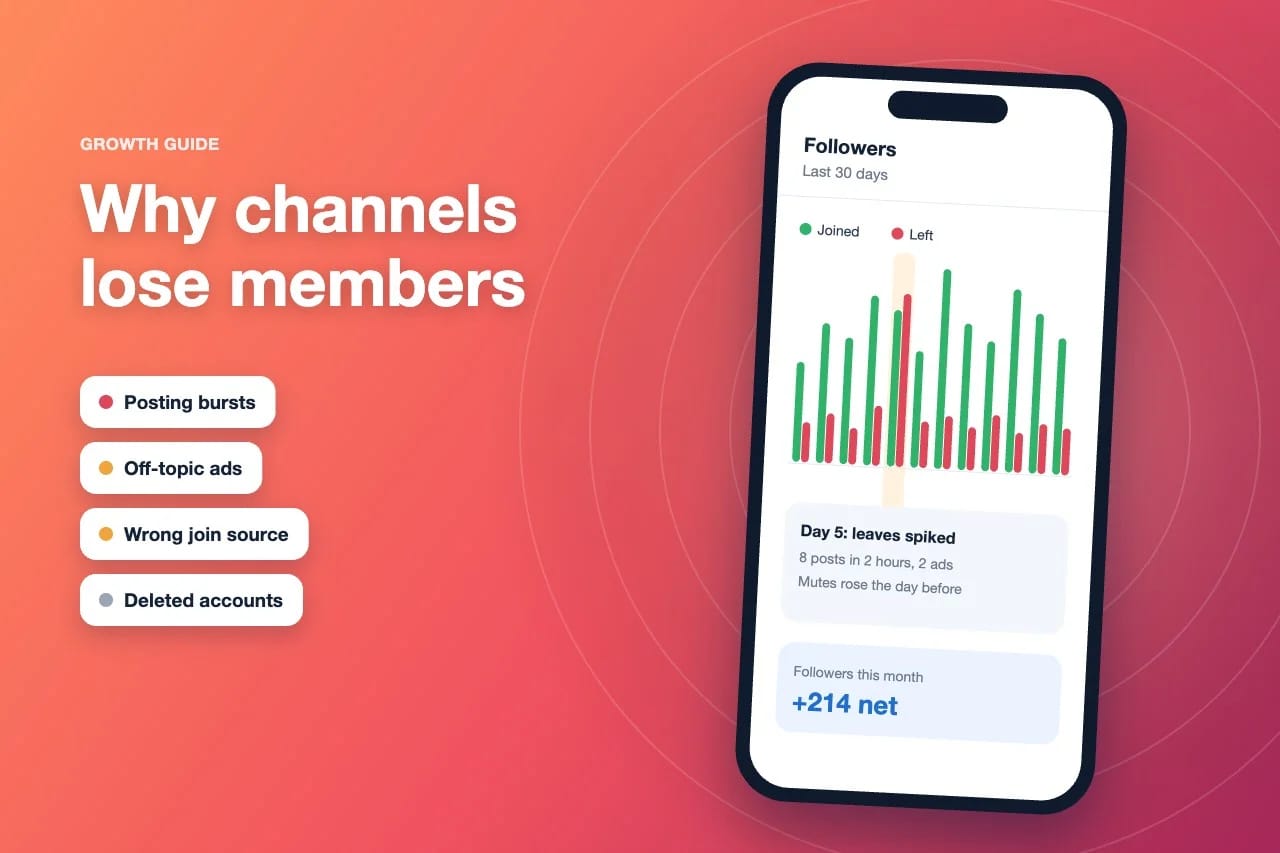
The followers graph. This splits each day into joined and left. Here you can see whether a bad week was a spike of leaves or simply a week with no joins.
The mute graph. This shows people muting and unmuting the channel. Muting usually comes before leaving. A rise in mutes after a change in posting style is an early warning you can act on before the leaves show up.
Two more help with the "why." New followers by source tells you where recent joiners came from, which matters because people who arrive through different doors leave at very different rates. And the per-post interactions data lets you line up a spike in leaves with what you published that day.
If your channel is still too small to have statistics, you can do a rough version by hand: note the member count at the same time each day for two weeks, alongside what you posted. It's crude, but it's often enough to spot the pattern.
What normal churn looks like
I don't publish a "normal" leave rate, and I'd be suspicious of anyone who does. It depends on topic, posting frequency, language and, above all, on how the channel got its members. But there are shapes that are normal, and once you know them you stop panicking at the wrong things.
A small, steady trickle. Some people leave every day for reasons that have nothing to do with you. They're cleaning up their chat list, their interests changed, they joined for one post. In a healthy channel this trickle is roughly flat over time and well below joins.
A drop after a growth spike. If a big channel shares your post and you gain 2,000 people in a day, a meaningful share of them will leave within a week or two. They came for one post. This is the most common "we're losing members" message I get, and it's not a problem. Judge the spike by how many people are still there a month later, not by the peak.
Slow erosion from deleted accounts. Telegram deletes accounts that stay offline for a period the user chooses. The default is 18 months. Old channels lose a few members every month this way, and nothing you post will change it.
What's not normal: leaves that jump and stay high, a week where leaves beat joins with no growth spike before it, or a fall in the total that lines up with nothing on your side.
The six reasons channels lose members
These are in the order I usually find them, starting with the most common.
1. Posting too much, or posting at the wrong rhythm
This is the one owners least want to hear. Every post can make a phone buzz. People who joined for one or two useful posts a day don't stay for eight. They mute first, and the mute graph shows it, then a share of them leave.
Rhythm matters as much as volume. A channel that posts nothing for four days and then twelve times in an afternoon feels noisier than one that posts three times a day every day. When I see a cluster of leaves in the followers graph, the first thing I check is whether it lines up with a burst of posts.
Two practical fixes help without cutting content. Batch small updates into one post instead of three. And send non-urgent posts silently: in Telegram you can hold the Send button and choose to send without sound, a feature Telegram introduced alongside silent messages and slow mode. Readers still see the post; their phone just doesn't make noise. Scheduled posts can be silent too. I use silent sends for anything that isn't time-sensitive, and it noticeably flattens the mute graph.
2. The content drifted from what people joined for
People join a channel for a reason. A crypto channel that starts posting lifestyle content, or a news channel that turns into an affiliate feed, loses people who joined for the old thing, and they leave quietly. You don't get complaints, you get a slow rise in leaves.
The fix is either to return to the original promise or to make the change openly and accept that some people will go. What doesn't work is drifting without saying anything, because then you lose the old audience without clearly attracting a new one. If your channel's description no longer matches what you post, rewrite one or the other.
3. Too many ads
Paid posts are how many channels pay for themselves, and readers accept some. What they don't accept is a feed where every third post is someone else's promotion, especially one that's off-topic. Ad-heavy days produce leave spikes you can see in the followers graph within hours.
I keep a simple rule on channels I run: no more than one paid post in a row, never two in a day if the channel posts fewer than five times, and nothing I wouldn't recommend to a friend. When an advertiser wants a placement that breaks those rules, the cost in leaves is usually higher than the fee.
4. The joiners came through the wrong door
Not all joins are equal. Someone who found you in search, or through a forward from a friend, joined because they wanted your content. Someone who joined to enter a giveaway, or because a bot made them join to unlock something, joined because they wanted something else. The second group leaves much faster.
This is where the new followers by source chart earns its place. If one source keeps bringing people who disappear within days, that source is costing you, even if its joins look impressive. I track this with separate invite links per promotion, a method I explain in my guide to growing a Telegram channel. A partner whose link brings 500 joins and 400 leaves in a fortnight sent you 100 readers, not 500.
5. Bought members dropping off
I sell Telegram members, so I'll be straightforward about this one. Members from any provider can drop over time. Some accounts get deleted, some get restricted, some leave. A reputable provider says how much drop to expect, delivers gradually and refills losses within a stated window. Our own terms are on the refund and refill policy page, and the pacing is explained on how delivery works.
You can usually tell bought-member drop from reader churn. It shows as leaves concentrated in the weeks after a delivery, with no matching change in views, because those accounts weren't viewing much to begin with. If your views per post hold steady while the count falls, you're losing count, not readers. That's worth knowing before you change anything about your content. I go into how to tell the two kinds of member apart in real vs fake Telegram members, and into what's safe and what isn't in is it safe to buy Telegram members.
6. Something outside your channel changed
Sometimes the cause isn't in your feed at all. A competitor launched and took the same audience. A topic you cover stopped being news. A partner who used to send you traffic stopped. A link to your channel that was pinned in a big group got removed. None of these show up in your posts, but they show up in the sources chart as a source that quietly went to zero.
How I diagnose a drop, step by step
When a customer or a friend sends me a screenshot of a falling count, this is the order I work in. It takes about twenty minutes with the statistics panel open.
Pick the window. Find the exact days where the total fell. Not "last month," the specific days.
Split joins from leaves. In the followers graph, check whether those days had more leaves than usual, fewer joins than usual, or both. Fewer joins is a promotion question. More leaves is a retention question.
Line up the posts. Scroll the channel to those days. Count posts, note ads, note anything off-topic. Most leave spikes have an obvious post or burst right before them.
Check the mute graph. If mutes rose a few days before the leaves, the problem is volume or relevance. If leaves jumped with no mutes before them, look for a single post, an external change or a batch of accounts dropping.
Check views. If views per post fell along with the count, you lost readers. If views held while the count fell, you lost accounts that weren't reading. My guide to getting more Telegram post views explains how to read views properly, and the engagement rate calculator turns them into a rate you can compare week to week.
Check sources. Look at where the leavers' cohort came from, if you track links per source. One bad source often explains most of the problem.
By the end of that, you usually have one main cause and maybe one secondary one. Fix the main one first. Changing five things at once means you'll never know which one worked.
How to reduce leaves without posting less
Cutting volume is sometimes the right answer, but it's not the only lever. These are the changes that have made the biggest difference on channels I've run.
Set expectations on day one. A short welcome post or pinned message that says what the channel posts, how often, and what it doesn't post filters out people who would have left anyway, and it reassures the rest. I covered how to set this up in my guide to Telegram welcome messages.
Give people a reason to unmute. If your best posts are buried among routine ones, readers mute everything. Make important posts look important: a clear first line, one per day at most, and the rest sent silently.
Use a discussion group. A channel with comments turned on gives readers a way to complain, ask and argue instead of just leaving. You also find out what annoyed them. My guide to Telegram channel comments covers how to set one up and keep it from turning into spam.
Watch reactions as a mood indicator. A run of posts with fewer reactions than usual often comes before a rise in leaves. It's a quick, visible signal that something isn't landing. I explain what normal reaction patterns look like in my guide to Telegram reactions.
Keep promotions on-topic. The cost of an off-topic ad isn't the leave spike on the day. It's the readers who mute you and stop opening the channel, who never show up in the leave count but stop showing up in views.
When to worry, and when not to
After years of watching these graphs, here's how I sort it.
Don't worry about a drop after a viral day, a few leaves every day, or slow erosion in an old channel. Don't worry about the count dropping slightly after a member delivery if views hold steady. And don't compare your leave rate with someone else's channel, because you can't see how they built their audience.
Do worry if leaves beat joins for several weeks running, if your views per post are falling along with the count, or if the mute graph is climbing. Those mean real readers are leaving or tuning out, and the cause is almost always in what or how much you post.
A note on "boosting the count back up"
When a count falls, the temptation is to replace the lost number quickly. I understand it, and it's literally my business. But if real readers are leaving because of what you post, adding members won't fix that. The new number will sit on top of the same problem, and you'll keep losing readers underneath it.
Fix the cause first. Once leaves are back to a normal trickle, then decide whether a bigger count would help you, for example to make the channel look established to new visitors or to meet a threshold you care about. If you do buy Telegram members at that point, do it with gradual delivery and a refill guarantee, so the number you pay for is the number that stays.
Where I'd start this week
Open your statistics and look at the followers graph for the last 30 days, not the total. Find the three worst days for leaves. Scroll to what you posted on each of them. In most channels that one exercise explains the majority of the losses, and the fix is something you control: fewer posts in a burst, fewer ads in a row, or a promotion source you stop paying for.
Frequently asked questions
Why is my Telegram channel losing members?
The most common causes are posting too often or in bursts, content drifting from what people joined for, too many ads, joiners from low-quality sources such as giveaways, bought members dropping off, and outside changes like a lost traffic source. The followers graph in your channel statistics shows which days leaves rose, and the posts on those days usually explain why.
Is it normal to lose subscribers on Telegram?
Yes. Every channel loses some members daily, loses more after a viral spike, and slowly loses deleted accounts over time. It becomes a problem when leaves beat joins for weeks or when views per post fall along with the count.
Can I see who left my Telegram channel?
Telegram's statistics show how many people joined and left each day, and where new followers came from, but not a list of the people who left. If you use a separate invite link for each promotion, you can see how many joined through each link.
Does muting a channel count as leaving?
No. A muted subscriber is still a member and can still read posts, but muting often comes before leaving. The mute graph in channel statistics shows how many people muted and unmuted the channel over time.
How do I stop people leaving my Telegram channel?
Post at a steady rhythm, batch small updates, send non-urgent posts silently, keep paid posts on-topic and spaced out, explain what the channel posts in a welcome or pinned message, and stop using promotion sources whose joiners leave within days.
Why did my member count drop after buying members?
Some purchased accounts drop over time through deletion, restriction or leaving. A reputable provider states the expected drop, delivers gradually and refills losses within a set period. If views per post stay steady while the count falls, you're losing accounts that weren't reading, not readers.