A new Telegram channel can publish something genuinely useful and reach almost nobody. That isn't a content problem. It's a distribution problem, and on Telegram the two get confused constantly.
The first thousand members aren't one problem either. They're at least six: giving someone a reason to join, getting the first real humans through the door, writing posts that survive being forwarded somewhere else, becoming findable inside the app, finding publishers worth working with, and then working out whether anyone you acquired actually reads.
The number beside your channel name is a useful signal. It isn't reach, and it isn't an audience. Most of the expensive mistakes in Telegram growth start by collapsing the two into one figure. "Zero to 1,000" is a way of thinking about stages, not a promise about a timeline.
How Do You Grow a Telegram Channel in 2026?
Growth on Telegram comes from stacking things that each do a different job.
Start by making the channel worth joining: one clear promise, a name and description someone can parse in seconds, and enough published posts that a visitor can judge you. Then seed the first audience from people who already have a reason to care — customers, your site, your mailing list, your accounts elsewhere. Give each source its own invite link so you can tell which one worked.
Next, write posts that still make sense when a stranger receives them as a forward, since forwards are how most small channels first reach outsiders. Use the discovery surfaces Telegram actually has: public channel search, the Posts tab in global search, and the Similar Channels list.
Then widen the funnel. Trade audiences with publishers whose readers overlap with yours. Bring people in from outside Telegram with a specific reason, not a bare "join my channel." Test paid distribution only once you know what a good subscriber looks like.
And measure views and forwards rather than the subscriber counter alone. The counter tells you how many people once tapped Join. It says nothing about who's still reading.
Before You Try to Grow, Give People a Reason to Join
Most channels that stall don't have a promotion problem. They have a positioning problem that promotion makes more expensive.
Here's the test. Open the channel as if you'd never seen it, look for about ten seconds, and ask whether you understand what you'd get by joining. Not what it's about. What you'd get. "Marketing" is a topic. "One teardown of a real ad campaign every Tuesday" is a promise. The second is easy to recommend to a friend. The first isn't, and that matters more here than on platforms where a feed does the recommending for you.
That promise has to show up in four places: name, username, description, profile photo. Keep the name readable rather than keyword salad. The username is what people type and what sits inside your t.me link, so shorter wins. The description is your one shot at the ten-second test. And a photo that reads clearly at chat-list size beats a detailed logo nobody can make out.
Narrow isn't a limitation. A specific channel is easier to describe, easier to recommend, and easier for a partner to introduce.
Don't Promote an Empty Channel
Sending traffic to a channel with three posts is the most common way to waste an opportunity. Every visitor who opens it, finds nothing to evaluate and leaves is someone you now have to reach twice, through a partner post, an ad, or a link you may not get to place again.
Before promoting anything, I'd want the channel to answer three questions on its own: what is this, is it any good, does it keep going. That means enough posts to judge quality rather than guess at it, at least one post in the format you want to be known for, and a pinned post that explains the channel in two lines.
I won't hand you a number, because it depends on what you publish. A daily news channel and a weekly analysis channel need very different amounts of visible history. My own rule is that scrolling should feel like a pattern rather than a false start.
Getting the First 100 Members
The first hundred are a different problem from the next nine hundred, and treating them alike is why channels stall at the start.
Cold acquisition is inefficient here. Nobody's recommending you, no partner wants to trade with a channel that has no audience, and paid placements are hard to justify before you know what a good subscriber looks like. So the first hundred should come from people with an existing reason to care: customers, your mailing list, site visitors, followers on platforms where you're already active, and communities where you're a known participant rather than a stranger with a link.
Those people convert better, and they behave differently afterwards. They read. They react. Occasionally they forward. That behavior tells you which posts work, and you can't learn it from an audience that never opens the channel.
One structural note: Telegram lets an owner add the first 200 subscribers directly, after which the channel is on its own. Telegram's Channels FAQ says so, and in the same section it asks publishers not to send channel links or other unsolicited messages to strangers, noting that spam reports can leave you unable to contact people regardless of your intentions. Take that seriously. Mass DMs, adding people who didn't ask, and dropping links into unrelated groups aren't slow tactics. They're a way to damage the account you're growing from.
Use a Different Invite Link for Every Source
This is the cheapest analytics you'll ever set up, and most new channels skip it.
Telegram lets admins create additional invite links, name them, set expiry dates and usage limits, turn them into QR codes, and require approval before admitting someone. Telegram's documentation confirms admins can also retrieve the list of users who joined through a specific link.
So with five traffic sources I'd create five named links: site footer, newsletter, profile bio, cross-promotion A, cross-promotion B. When forty people arrive in a week, I don't have to guess where they came from. That's an illustration, not a benchmark.
It isn't a full analytics suite. No funnels, no per-source retention. What you get is the difference between "we grew a bit this week" and "the newsletter did most of it and the partnership brought nobody." That's enough to make a decision with.
Make Posts That Still Work When Someone Forwards Them
A forward is one of the few ways a small channel reaches people who've never heard of it, and forwarded copies count toward your post's view total, so you can see it happening.
The thing to internalize is that a forward arrives without context. Your subscriber reads a post inside your channel, after your last twenty posts, already knowing what you do. The person receiving the forward is in some other chat, sees one message, and has no idea who you are. I write differently for that second reader, because the post has to survive alone.
Forwardable posts share a few traits. They work as a single message rather than part three of a series. They deliver something immediately, whether a number, a method or an answer, instead of promising value later. They have one clear subject. And they make the channel legible without becoming an advertisement for it; a post that's mostly self-promotion doesn't travel, because forwarding it makes the sender look like your marketing department.
Formats that travel well include short explainers, checklists, templates, condensed guides, timely analysis while a topic is live, and curation where the selection itself is the value. But I'd resist the idea that one format always wins. What travels in a crypto channel and what travels in a channel for pharmacists aren't the same thing.
Telegram Discovery in 2026 Is Bigger Than Search
A lot of guides open with some version of "Telegram has no discovery — nobody will ever find you." That was always overstated, and in 2026 it's misleading.
The accurate version: Telegram doesn't work like TikTok or Instagram. There's no general algorithmic feed pushing every new post to large cold audiences, and no Explore tab. But Telegram has discovery surfaces, several of them, and they behave differently from each other.
Channel Search
Public channels have a username and appear in Telegram search. That's the baseline, and it's why public is the default if growth matters to you.
Telegram has never published a ranking formula for this, and I'd treat anyone claiming to know it with suspicion. What you control is whether your channel is intelligible: a name and description using the words your audience would actually type, rather than internal branding nobody searches for.
Public Post Search
In 2025 Telegram added a Posts tab to global search, showing relevant results from public channels. It launched to Premium users first, so availability depends on the account doing the searching — worth checking in your own app rather than assuming.
This matters because the old advice was that only your channel name and description were findable and the content of posts was invisible. That's no longer accurate.
What I wouldn't do is turn it into a keyword exercise. Telegram publishes no ranking factors for post search and I'm not going to invent any. The reasonable adjustment is small: name the thing your post is about in the words people use for it, and make posts self-contained enough that landing on one cold still makes sense. That's good writing that happens to help searchability, which is different from a documented ranking signal.
Similar Channels
Open or join a public channel and Telegram can show a list of similar ones. Telegram's own description is specific: selected automatically based on similarities in their subscriber bases.
That's the whole documented mechanism. Not keywords, not engagement rate, not reactions, not a subscriber threshold that unlocks recommendations. If a guide tells you that posting more or collecting reactions improves your placement, that claim isn't coming from Telegram.
Here's my reasoning on top of that, labeled as reasoning: if the signal is subscriber overlap, then who joins matters more than how many. A thousand members who also follow channels in your niche describe a coherent audience. A thousand assembled from nowhere in particular describe nothing. I can't prove that translates into placement and won't pretend otherwise — but it's a better bet than treating recommendations as something you can game.
Telegram Communities Are New — and Worth Understanding
On July 14, 2026, Telegram introduced Communities: several channels, groups and bots linked together around a shared topic. Members can see the other chats and join them instantly without an invite link, and the whole thing can sit in the chat list as one item that expands.
Two details matter for publishers. Chats inside a community can be Visible to all members or Hidden from everyone except community admins and members of that chat. And communities are collaborative by default — any member can add more chats — though you can restrict that in settings, after which additions show up as suggestions instead.
The use case is architectural rather than promotional. If you already run a broadcast channel, a discussion group attached to it, and a bot that does something useful, those are three destinations people currently find one at a time. A community makes them one destination with three rooms.
What I wouldn't do is manufacture chats in order to have a community. A single channel with one clear job doesn't need a group, a bot and a second channel bolted on for structural reasons. That produces empty rooms, and empty rooms make you look smaller.
Cross-Promotion: Look at Audience Fit Before Member Count
Trading exposure with another channel is a real growth mechanism, and it's where the sloppiest evaluation happens, because there's one number sitting right at the top of the profile.
Subscriber count is the weakest signal available about a partner. Before agreeing to anything I'd look at recent post views against member count, whether those views are consistent or spiky, how often the channel runs promotions versus actual content, and whether topic, language and geography genuinely overlap with mine. A channel writing in a language my readers don't speak is wasted reach at any size.
Consider two hypothetical partners. One has 40,000 members, its last ten posts average around 900 views, and three of those ten were paid promotions. The other has 4,000 members averaging around 1,400 views and promotes something roughly once a month. I'd take the second: smaller, more read, and its audience hasn't been trained to scroll past promotional posts.
I won't give you a conversion rate to expect, because there isn't a universal one and every published figure I've seen is either unsourced or specific to one niche. Give the partnership its own invite link and find out.
Bring People to Telegram From Outside Telegram
Most channels that grow steadily are pulling people in from somewhere else: a website, a newsletter, a YouTube channel, an X account, a customer email, a forum where the publisher has a real reputation.
The mistake is treating this as a link-placement exercise. "Join my Telegram" in fifteen locations converts poorly everywhere, because it asks for a commitment without naming a reason. What works is being specific about what happens in Telegram that doesn't happen where the person is standing: faster alerts on something they track, the longer version of an argument you summarized elsewhere, a resource you send to subscribers, or somewhere they can actually ask you something.
Be honest about the reason, though. Manufactured exclusivity, meaning subscriber-only content you have no intention of producing, costs more than a weak call to action, because the people who join on that promise are the ones who mute you a week later.
When Paid Promotion Starts to Make Sense
Three different things get filed under "paid Telegram growth," and they don't do the same job.
Direct paid placements. You pay another channel to publish a post about yours. You're buying access to a specific audience, and the result depends almost entirely on how well that audience matches yours. Telegram now has a native mechanism for arranging this: suggested posts, where you send a channel a proposed post along with an offer in Stars or Toncoin, both sides can edit and agree before it goes live, and the owner is paid 24 hours after posting, with the amount returned automatically if the post comes down earlier.
Official Telegram Ads. Telegram's own platform, covered next. You're buying impressions in contexts you select, not a relationship with a publisher.
Paid member services. You pay for accounts to be added to your visible member count. You're buying a number on a profile, not readers.
The first two are audience acquisition. The third is social proof. They're sold in similar places and described in similar language, which is why they get conflated — and why people end up disappointed by results they were never actually purchasing.
Using Official Telegram Ads
Telegram Ads runs sponsored messages inside public channels, and the platform documentation is worth reading directly rather than through somebody's blog. Per Telegram's Ad Platform documentation, ads appear in public one-to-many channels with 1,000+ subscribers, and you choose the channels your ads run in by entering their links.
A few constraints shape everything. Every link, in the text and on the button, must point to a channel or bot on Telegram; external websites aren't allowed. Pricing is CPM, and the documented minimum is 0.1 Toncoin per thousand views. Targeting can't be edited after an ad is created, though there's a "create similar ad" function for variants. And the statistics tab reports views alongside the number of times someone joined your channel or started your bot after seeing the ad, which is the number that actually matters to you.
I won't give you an expected cost per subscriber. It varies enormously by language, region and competition, and the figures circulating come from individual campaigns rather than from Telegram.
What I'd test first is context. Placements sit inside channels you picked, so the closest thing to a targeting lever is choosing channels where your offer makes sense to someone mid-scroll. Run something small in a handful of clearly relevant ones, keep the message concrete rather than clever, vary the wording across a few ads, then check two weeks later whether those subscribers are still opening posts.
Should You Buy Telegram Members?
This deserves a straight answer rather than a pitch. Buying members changes a number on your profile. It doesn't produce readers, forwards, reactions, comments, retention or organic growth, and anyone telling you otherwise is selling under false pretences. The risk side of the question, meaning Telegram's rules, bans and drops, has its own guide: is it safe to buy Telegram members?
The market exists because the number is visible, and humans use visible numbers as a shortcut. A visitor landing on a channel showing three members and one landing on a channel showing three thousand will evaluate identical content differently, whether or not that's rational. Publishers assessing partnerships do it too. That effect is real, and it's the only thing paid members reliably deliver.
What they don't do is worth stating explicitly, because the claims are everywhere. Purchased members don't influence Similar Channels, which Telegram says is built from subscriber-base similarity. They don't affect search. They don't create engagement.
There's also an underestimated cost. If your member count goes up and your views don't, the ratio between them gets worse, visibly, on every post you publish. An experienced publisher evaluating you for a partnership looks at exactly that ratio. The number that was supposed to be social proof becomes the thing that disqualifies you.
If you decide the visible-proof problem is worth solving in your situation and you want to buy Telegram members, treat it as cosmetic groundwork rather than growth. BroadcastLift sells Telegram channel members, and the honest framing is that it addresses how a channel looks, not how it performs. Keep the scale proportionate to the views you can realistically generate, and watch for obvious mismatches. Services that let you specify members from particular countries exist because a channel written in Turkish with an audience that appears entirely unrelated reads as a signal, not as proof.
The more important note: none of this substitutes for the rest of this guide. Follow everything else here and buy nothing, and the channel still grows. Buy members and do nothing else, and you own an expensive number.
Member Count Is Only Half the Picture — Watch Your Views
Every channel post carries a view counter, and Telegram is unusually candid about what it measures. Per the Channels FAQ, views from forwarded copies are included in the total, the numbers are approximate by design, and after roughly four days Telegram forgets you saw a post and counts you again if you return to it.
That cuts both ways. Your view count reflects circulation beyond your own subscriber list, which is exactly what you want to see. It also isn't a clean count of unique humans, so treat it as a trend rather than a census.
Now the diagnostic. Two channels:
Channel A — 1,000 members, recent posts averaging around 650 views.
Channel B — 5,000 members, recent posts averaging around 400 views.
B has five times the members and fewer readers. That doesn't automatically make A better. B might have grown fast from a broad campaign and be weeks from a settled audience, or publish ten times a day and split attention across posts. A might be a niche professional channel where every subscriber cares. The ratio raises the question. It doesn't answer it.
To compare recent views against member count quickly, our Telegram engagement rate calculator does the arithmetic. Just be clear about what you're holding: a diagnostic ratio you compute yourself, not a score Telegram assigns you. Telegram publishes no channel quality metric. The ratio is useful for tracking your own trend and sanity-checking a partner. It isn't a grade.
Telegram also provides native statistics: follower changes, views and shares per post, reactions, the share of subscribers with notifications enabled, and where views and new followers came from. Telegram's documentation states these are available to admins of channels above a certain size, with the exact limit set server-side rather than published. A brand-new channel may not see the full statistics screen at all, which is why I'd log the average views of my last ten posts manually from day one. When those follower changes start showing more leaves than joins, I walk through how to read them in why your Telegram channel is losing members.
Views, Reactions, Comments and Polls Tell You Different Things
Bundling these into a single "engagement" figure destroys the information they contain.
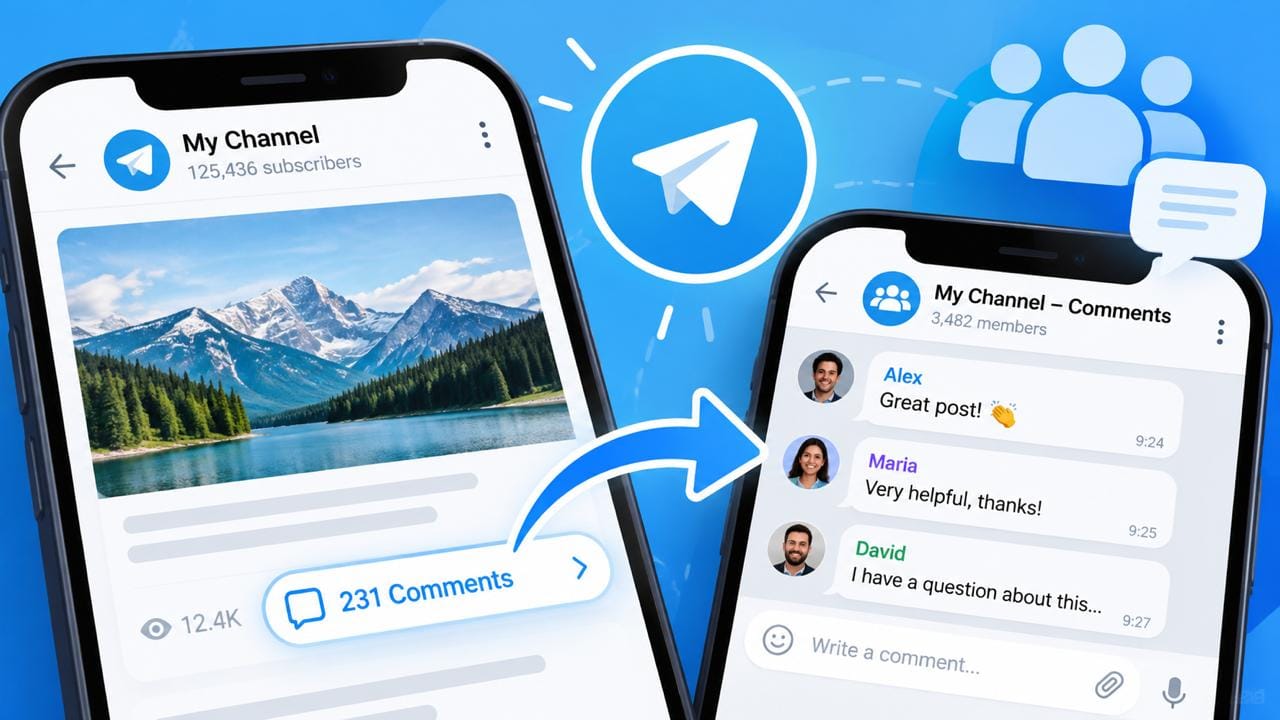
Views tell you whether posts got opened at all — the ceiling on everything else. Reactions tell you whether readers would spend one tap on feedback; they're cheap to give, which makes them a decent read on sentiment and a poor read on intensity. Comments, which run through a linked discussion group, tell you whether a post provoked something worth saying out loud. If your channel doesn't have one yet, here's how to enable comments on a Telegram channel. Poll votes tell you whether people will take a deliberate action, and unlike the others they hand you usable information about what your audience wants before you commit to producing it.
Channels are healthy in different shapes. A breaking-news channel can have very high views and near-zero comments and be working exactly as intended. A small professional channel can have modest views and a busy thread under every post and be worth far more to its owner. Neither pattern is a problem. A pattern that changed suddenly is worth investigating.
This is also the honest frame for the services sold alongside members: post views and reactions are separate products because they're separate signals, and inflating one while the others stay flat produces a profile that reads as inconsistent to anyone who looks closely.
A Practical Path From 0 to 1,000 Members
The work changes as you go. Attaching dates to these stages would be dishonest. A channel serving an existing customer base and one starting cold in a crowded niche move at completely different speeds, and identical tactics produce different results across niches and languages.
Stage 1: 0–100. Positioning, initial content, your existing network. Set up source-specific invite links before promoting anything. The output isn't the member count; it's learning which posts people actually read.
Stage 2: 100–500. Turn what worked into something repeatable. Publish for forwards. Approach cross-promotion partners now that you have something to show them. Push traffic from your site and accounts. Watch whether views hold steady as members grow.
Stage 3: 500–1,000. Repeat the partnerships that worked rather than chasing new ones. Run larger distribution tests. Consider controlled paid promotion if you now know what a good subscriber costs and looks like. And spend real attention on retention — keeping the audience you have is usually cheaper than acquiring the next hundred.
What I Would Do With a Brand-New Telegram Channel
If I were opening a channel tomorrow, roughly this order.
Write the promise in one sentence and refuse to start until it's narrow enough to be interesting. Build a small backlog of posts before anyone sees the channel, and pin the one that best explains what this is.
Before promoting anything, create the invite links: one per source, named. Ten minutes of work that saves weeks of guessing.
Then go to the people who already have a reason to care, and only them. No cold outreach, no links dropped in groups where I'm not a participant. While that first group arrives, watch two things: which posts get views beyond my member count, and which get forwarded. Those are the posts telling me what to make more of.
Once there's something worth showing another publisher, start identifying adjacent channels, not by size, but by whether their recent posts get read. Approach a small number properly, with a specific proposal rather than a generic swap request.
Paid distribution comes last, and only once I can answer one question: what does a subscriber from each source do in the two weeks after joining? Without that, spending money just buys a number faster.
Later, once people are reading, channel boosts are how a channel unlocks extra features as it grows.
Common Telegram Growth Mistakes
Promoting before the channel can be evaluated. Traffic to an empty channel is traffic you'll buy twice.
Watching subscribers and ignoring views. The counter rises whether or not anyone is reading.
Acquiring the wrong audience. Members who don't care don't read, don't forward, and make your ratios worse.
Using one invite link everywhere. You lose the ability to tell which source works, permanently and for no reason.
Spam promotion. Unsolicited messages and links in unrelated groups can get your account restricted.
Picking partners by subscriber count. It's the least informative number on the profile.
Republishing other channels' content wholesale. If your channel is a copy, there's no reason to follow it instead of the original.
Publishing whatever seems interesting today. A channel without a pattern is one nobody can describe to a friend.
Paying for traffic without measuring what happens next. Subscribers who mute in week one cost the same as the ones who stay.
Assuming an undocumented algorithm explains everything. Telegram publishes very little about ranking. Most confident claims about it are invented.
Treating purchased members as an acquired audience. They're a visible number, and only that.
Expecting one tactic to work everywhere. What grows a crypto channel and what grows a channel for legal professionals are different playbooks.
A 30-Day Telegram Growth Plan
This is a work plan, not a promise about a member count. Nothing here says you'll have 1,000 members in 30 days, and any guide that does is guessing. What it gives you is a channel set up properly and a month of real data about your specific niche.
Week 1 — Foundation. Write the one-sentence promise. Set the name, username, description and photo against the ten-second test. Publish enough posts that the channel can be judged, then write and pin the post explaining what this is. Create your named invite links, one per planned source. Record your baseline: date, member count, average views of your last few posts.
Week 2 — First distribution. Go to your existing audience (customers, list, site, other accounts) with a specific reason to join, using the right link for each. Publish at least two posts built deliberately to work as forwards. Start a shortlist of partner channels, noting recent view counts rather than subscriber counts.
Week 3 — Partnerships and discovery. Approach three to five partners with a concrete proposal, each with its own invite link. Review whether your name, description and recent posts use the language people actually search for. Check your Similar Channels list, which is a free read on what audience Telegram associates you with. If you already run a group or bot, consider whether a Community makes them easier to move between.
Week 4 — Measure and decide. Compare average views across your last ten posts against your Week 1 baseline. Note which posts got forwarded and what they had in common. Check reactions, comments and poll participation separately rather than as one figure. Look at growth per invite link and work out your cheapest real source. Then decide, with numbers in front of you, whether paid acquisition is justified yet.
Frequently Asked Questions
How do I get my first 100 Telegram members? From people who already have a reason to care: customers, your mailing list, site visitors, followers on other platforms, and communities where you're an established participant. Telegram lets an owner add the first 200 subscribers directly, but adding people who didn't ask tends to produce mutes rather than readers. Give each source its own invite link so you learn which one works.
How long does it take to reach 1,000 Telegram members? There's no universal timeline, and anyone quoting one is guessing. It depends on whether you already have an audience elsewhere, how competitive your niche is, what language you publish in, how forwardable your posts are, and whether you're spending money. A channel launched to an existing customer base and one starting cold are not the same project.
Can a Telegram channel grow organically? Yes, though "organic" means something specific here. It mostly means forwards, shares, search and Telegram's own discovery surfaces, not an algorithmic feed pushing your posts at strangers. Telegram doesn't distribute content to cold audiences the way TikTok does, so organic growth here depends largely on whether existing readers pass your posts along.
Does Telegram recommend channels? Yes. Telegram shows a Similar Channels list on public channel profiles, and states these are selected automatically based on similarities in subscriber bases. That's the only documented mechanism. Claims that keywords, reactions, posting frequency or a subscriber threshold control placement aren't supported by anything Telegram publishes.
Are Telegram posts searchable in 2026? Yes. Telegram's global search includes a Posts tab showing relevant results from public channels, launched to Premium users first. The old advice that only channel names and descriptions are findable is outdated. Telegram publishes no ranking factors for post search, so write clearly in the words your audience uses rather than stuffing keywords.
Should my Telegram channel be public or private for growth? Public is the default if discovery matters: public channels have a username, appear in search, and can surface in Similar Channels lists. Private channels aren't useless for growth. They work well for paid communities and anything where controlled access is the product — but you're then growing entirely through links you distribute yourself.
How often should I post on Telegram? There's no magic number, and the published ones are usually invented. Frequency depends on your niche, content type, how time-sensitive the topic is, and whether posting more causes people to mute you. Telegram delivers every post as a notification to anyone who hasn't muted, which makes over-posting costlier here than on feed-based platforms. Watch mutes and views, not a schedule.
Should I buy Telegram members? Only if you understand you're buying visible social proof rather than an audience. Purchased members don't read, forward, react or convert, and there's no documented mechanism by which they improve search visibility or Similar Channels placement. They can also backfire: if members rise while views don't, the ratio everyone judges you by gets weaker.
What is a good Telegram engagement rate? There's no universal benchmark, and any percentage you see published is almost certainly one person's channel generalised into a rule. It varies by niche, channel age, posting frequency, how the audience was acquired and what window you measure. The useful comparison is against your own channel over time, or against a specific partner. Run the numbers on both and compare like with like.
The Part Worth Remembering
The goal was never to make the number beside the channel name bigger. Anyone can do that, and there are services that will do it for you this afternoon.
What's harder, and what actually pays, is assembling four things that reinforce each other: the right people, content they keep opening, distribution that reaches past the people you already have, and measurement honest enough to tell you when something isn't working.
If you take one habit from all of this, make it the invite links. Not because attribution is glamorous, but because most people running Telegram channels genuinely can't tell you where their last hundred members came from, and you can't repeat what you can't identify.