I sell Telegram members for a living. I'm putting that in the first line because it should change how you read everything below it — and because almost every other guide on this topic is written by an agency with something to sell that doesn't tell you what it is.
At BroadcastLift I've delivered several thousand orders. The majority of them came from crypto projects. That surprised me early on and then stopped surprising me entirely: crypto is more active on Telegram than any other industry I work with, by a wide margin. Token launches, trading desks, mining operations, NFT projects — they all end up in the same place, and they all end up needing the same thing.
That volume gives me a specific and fairly narrow view. I don't see your tokenomics, your treasury, or your investor calls. What I do see is the order, the channel it lands in, and — often enough — the follow-up message three weeks later. I see which channels turn a subscriber list into an actual community and which ones stay silent forever. After a few thousand of those, patterns show up that you don't get from reading marketing blogs.
This article is those patterns. Where I have direct evidence from my own order data, I'll say so. Where I'm handing you an opinion, I'll flag it as one. And where buying members is the wrong move, I'll tell you that too — I would genuinely rather lose an order than watch a channel go quiet with my delivery sitting in it.
Why crypto ends up on Telegram and stays there
Every few months someone announces that crypto is migrating to Discord, or X, or whatever launched last quarter. From where I sit, watching where orders actually go, it hasn't happened. Telegram keeps winning for reasons that are structural rather than fashionable.
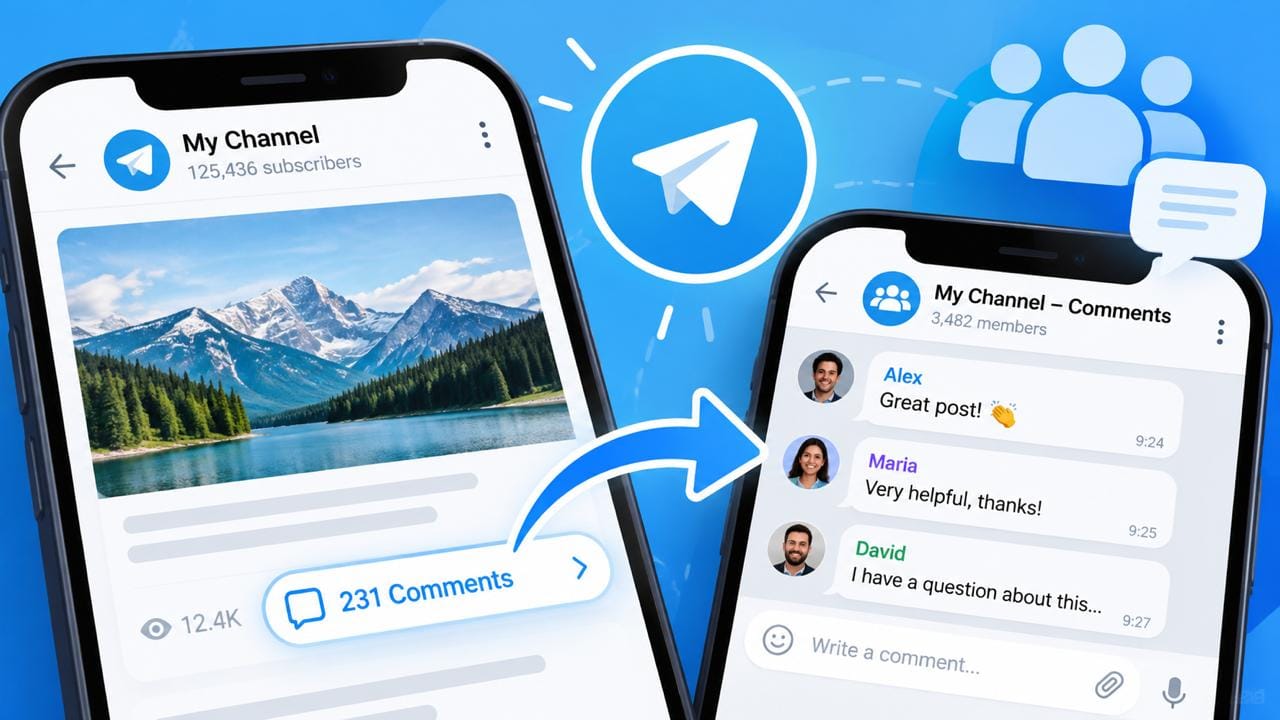
The first is the split between broadcasting and talking. A Telegram channel is a one-way megaphone — only admins post — and it can hold an unlimited number of subscribers. A group is a room where everyone talks, capped at 200,000 members. Crypto projects need both, and Telegram lets you run them as two linked objects instead of forcing one messy compromise. Your announcements stay clean and quotable; your community argues in the attached discussion group without burying the roadmap update.
The second is that channels carry a public view counter on every post. That number sits there for anyone to read. In most industries it's a vanity stat. In crypto it's a due-diligence signal — the first thing a market maker, a listing team, or a moderately careful retail buyer looks at when they land on your channel. It's also, incidentally, the number that exposes fake growth faster than anything else, which I'll come back to.
Third, the native tooling is good enough that most projects never need anything else. Reactions, quiz-style polls, scheduled posts, pinned messages, silent notifications, comment threads, and live streams all ship in the app. Once a channel passes 500 subscribers, Telegram unlocks a full statistics panel — growth over time, per-post reach, subscriber languages, and where new members came from. That last graph is the single most useful piece of free data you have, and I'd guess nine out of ten project owners I deal with have never opened it.
Fourth, and least discussed: Telegram is where the money already is. Wallets, trading bots, and mini apps run natively inside the client. Your community doesn't have to leave the app to act on what you post. No other platform has collapsed the distance between "announcement" and "transaction" that far.
The timing mistake that costs projects the most
This is the pattern I'm most confident about, because it shows up in my order data rather than my intuition.
Almost every crypto order I receive comes in before listing. Founders who know what they're doing build the room first and open the doors second. The orders that arrive after a token is already listed are the ones I've learned to worry about, and the one I think about most was exactly that: a project that came to me only once it was trading, trying to build a community around a chart that already existed.
It doesn't work the same way, and the reason is straightforward once you've watched it a few times. Before listing, your community is the evidence. It's what you show an exchange, a market maker, a KOL deciding whether to take your call. Members join because they want to be early, and "early" is a genuine, non-transferable incentive — you can only offer it once.
After listing, that incentive is gone. Now the first thing a new member does is not read your pinned message. It's check the price. Your community is no longer proof of anything; it's a room where people evaluate a number that already has a history. And if that room is visibly, suddenly full when it wasn't a week ago, the read isn't "this is growing." The read is "this is damage control." I've watched that interpretation form in real time in discussion groups, and it's very hard to argue your way out of.
My recommendation — and this is an opinion, not something my data proves — is to start building four to eight weeks before you list. That's enough time to accumulate real conversation history, to find out which of your moderators actually shows up, and to make the growth curve look like a curve instead of a step. A channel with three weeks of genuine back-and-forth in it reads completely differently from one with the same member count and no archive.
If you're already listed and your community is thin, buying members is not the fix. Fix the reason the room is quiet first. Adding people to a silent channel just gives more witnesses to the silence.
If you do decide to seed a channel before launch, what a category-weighted crypto member order is and is not is set out on the crypto members page. The rest of this guide is about the community you have to build around it, which no order can supply.
The numbers I'd hold a crypto community to
Most founders track exactly one number — member count — and it's the least informative one available. Here's what I'd actually watch, with the caveat that these are working benchmarks from what I see, not laws.
Views as a percentage of members
This is the ratio that matters most, and it's the one everyone can see. On a fresh channel, roughly 20% of your members should be showing up as post views within the first 24 hours. New channels over-index here: the subscriber list is recent, nobody has muted you yet, and notifications are still doing their job.
On an older channel that number is different, and this is where people panic unnecessarily. Established channels often see higher absolute view counts but a lower ratio, because a subscriber list accumulates people who joined months ago and stopped opening the app. Views drift down over time as a percentage. That drift is normal. What isn't normal is a cliff — a ratio that collapses in days rather than months, which usually means either your content changed or your last batch of growth wasn't what you thought it was.
If your ratio is under-performing and your content is genuinely good, that's the situation where post views are a reasonable supplement, because the underlying problem is reach rather than quality. I've written separately on getting more Telegram post views and most of that advice is free and structural — posting time, format, and length do more than anything you can buy.
Engagement, not attendance
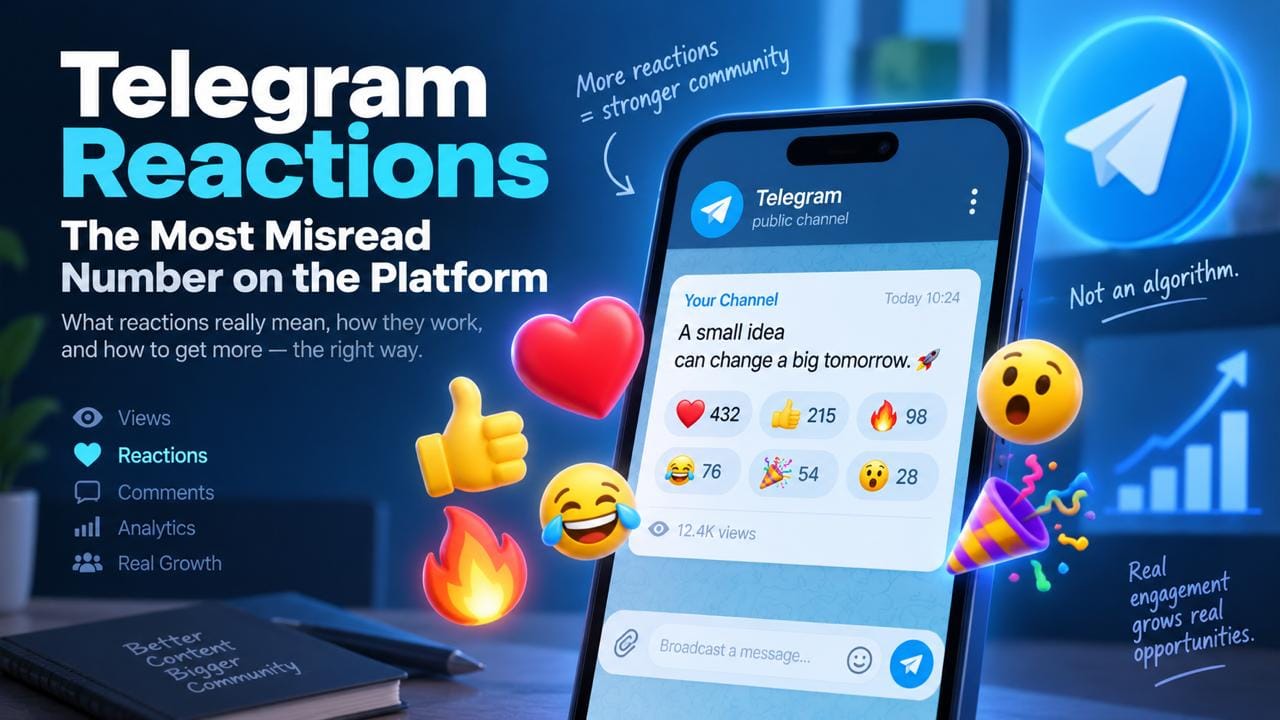
Views tell you people opened the post. Reactions and poll responses tell you they had a reaction to it. For a group, the number I'd care about is unique people posting per day, not total messages — twenty people having a real conversation is worth more than four people arguing loudly, and vastly more than a member count with nobody in it.
You can run your own numbers through our Telegram engagement rate calculator if you want a consistent way to track this week over week. The absolute number matters less than the trend line. A community whose engagement rate is climbing while its member count is flat is healthier than one where the reverse is true, and I'd take the first one every time.
The growth curve shape
Open your channel statistics and look at the growth graph as a shape rather than a total. Organic growth is lumpy — spikes around announcements, plateaus in between, a slow baseline underneath. Purely artificial growth is a clean vertical line with nothing before or after it. Anyone doing diligence on you will look at this graph. You should look at it first.
Paid seeding versus bot farms: the part nobody writes honestly
Every guide on this subject does one of two things. It ignores paid growth entirely, or it declares that buying members "almost always introduces fake accounts and destroys your engagement ratios." The second one is closer to true than the first, and it's still not the whole picture. Let me give you the version I'd give a friend. For the rules-and-bans side of the question, see is it safe to buy Telegram members.
What seeding legitimately solves
There is exactly one problem paid members solve well, and it's the cold start. Social proof is a threshold function, not a linear one. Nobody joins a 40-member channel for a project claiming a serious raise — not because 40 is a small number, but because 40 contradicts the claim. That mismatch between what you say you are and what your channel looks like does more damage than an empty channel ever would. Seeding closes that gap so your actual marketing has something to land in.
What it does not solve, at all
It does not create conversation. It does not hold a price. It will not survive serious institutional diligence as a headline number, and anyone telling you otherwise is lying to you. If your plan is "buy 50,000 members and the community will form itself," save your money — I've watched that plan fail enough times to tell you the outcome in advance.
The drop-rate question, answered honestly
This is the question I get more than any other, and my answer costs me sales: I can't give you a drop rate for real members. Not because I'm hiding it — because real members are real accounts operated by real people, and a person can decide to leave your channel on Tuesday for reasons that have nothing to do with me or you.
So when a provider quotes you a guaranteed zero-drop rate on "real" members, one of two things is true. Either the members aren't real — bot accounts don't leave, which is exactly why the number is guaranteeable — or they're planning to quietly refill behind the scenes and call it stability. Both are worth knowing about before you pay.
Pace is the tell
My delivery runs at roughly 10,000 members per 24 hours. Faster is technically possible. I don't do it, and I'd be suspicious of anyone who does. A channel that goes from 200 to 50,000 members in an hour looks precisely like what it is, and it looks that way permanently — that spike stays in your statistics graph forever, visible to everyone who checks. Gradual delivery isn't a technical limitation, it's the entire point. You can read the mechanics on how delivery works if you want the specifics.
When I'd tell you not to buy
You have no content plan. Members arriving at a channel with nothing to read will mute it within a day and never come back. Fix the content first; the members will still be available next week.
You have no moderator awake during your audience's hours. An unmoderated crypto group fills with scam DMs and impersonators faster than you'd believe. Adding members to an unmoderated room actively harms you.
You're already listed and panicking. Covered above. This is the single worst time to do it.
Your channel has zero posts. The archive is what converts a subscriber into a participant. Post for two weeks first, even to nobody.
How to check whether members are real
This section exists because nobody else writes it, and it's the thing every project owner actually needs — whether they're evaluating a provider, checking a competitor, or auditing a channel before a partnership. None of these checks require a paid tool.
Sample the member list by hand. Open it and look at twenty to thirty accounts properly. You're looking for variety: a mix of profile photos and blank ones, bios that read like people wrote them, usernames that follow different conventions. What you don't want to see is a uniform block — same username pattern, same empty bio, same creation-era look, all in a row.
Compare views to members after 24 to 48 hours. The most reliable single test there is. If a channel took on 10,000 members and its post views didn't move at all, you have your answer without needing anything else.
Post a poll. This is the cheapest realness test in existence and almost nobody uses it. A poll asks for one tap. A list of inactive accounts will not vote. If you have 30,000 members and a poll pulls eleven responses, that gap is the story.
Watch the discussion group, not the channel. Channel subscribers can be silent legitimately. A linked group where nobody has ever posted, attached to a channel with tens of thousands of members, is a much louder signal.
Read the growth graph shape. As above — vertical lines with no organic tail are a specific signature and you'll recognise them immediately once you've seen one.
Check reaction spread. Real audiences distribute across multiple emoji unevenly and unpredictably. A single reaction type in a suspiciously round quantity is worth a second look.
Run these on your own channel before you run them on anyone else's. Founders are frequently surprised by their own numbers.
The organic engine you still have to build
Everything above is scaffolding. This is the building, and there's no way to buy it.
Cadence beats volume. A crypto community dies in the gaps between announcements, not during them. Most projects post heavily around a milestone and then vanish for eleven days, which trains people to mute you. Something every day is better than something excellent twice a month — market context, a build update, a question, a chart, anything that gives a reason to open the app.
Separate the channel from the group properly. The channel is signal, the group is noise, and both are necessary. When you merge them, the announcement people came for gets buried under forty messages about the price, and both audiences leave unhappy.
Run AMAs with actual preparation. Collect questions in advance, answer the uncomfortable ones first, and post a transcript afterward for the people who couldn't attend. An AMA that dodges the hard question is worse than no AMA — the community noticed, and now they know you'll dodge.
Write an onboarding pin. New members land and need to know four things within ten seconds: what this project is, where the official links are, what the rules are, and that nobody from the team will ever DM them first. That last line prevents more losses than any bot you can install.
Cover the hours your community is awake. Crypto is genuinely 24-hour and your moderators are not. Decide honestly which timezones you can cover and recruit for the gaps, or restrict posting overnight. An unwatched group at 3am is where the impersonation attempts happen.
Much of the platform-level growth mechanics — discovery, cross-promotion, formatting, posting times — applies to any channel, crypto or not. I've covered that groundwork in detail in how to grow a Telegram channel, and I'd read that alongside this one rather than instead of it.
If you have real budget and want paid distribution that doesn't touch member counts at all, Telegram's official ads platform places sponsored messages inside public channels. It's the only advertising route on the platform that Telegram itself operates.
Setup and defence
Crypto communities attract a specific class of attacker, and the defences are unglamorous but non-optional.
Structure: one announcement channel, one linked discussion group, and — once you're large enough to need it — a separate room for holders or contributors. Three objects, clearly labelled, linked from the pin.
Verification on entry: a captcha bot at the group door stops the majority of automated joins. It also costs you a small percentage of legitimate members who can't be bothered, which is a trade worth making.
Anti-impersonation: the most common attack on a crypto Telegram group isn't a raid, it's someone copying your admin's display name and photo and DMing your members individually. Pin the "we never DM first" rule. List your real admin usernames in the pinned message. Repeat it after every announcement — the attack works precisely because new members haven't read the pin yet.
Bots, chosen carefully: Telegram's bot platform is genuinely powerful and every bot you add is a party with access to your group. Be selective. A free moderation bot with vague ownership is a data risk, not a saving.
Mistakes I see most often
Treating member count as the deliverable. It's an input. The output is people who show up when you post.
Buying once instead of matching growth to milestones. Growth that lines up with announcements looks like a project working. Growth in one lump looks like a purchase.
Announcing into silence. If your last six posts got no reaction, a seventh won't fix it. Ask a question instead.
No moderator during the community's waking hours. Covered above; it's the most expensive omission on this list.
Copy-pasting the same announcement across every channel. Your Telegram audience is not your X audience and the format shouldn't be identical.
Going quiet between milestones. The gap is where communities actually die.
Frequently asked questions
How many members does a crypto Telegram community need before launch?
There's no universal number — what matters is that your member count doesn't contradict your other claims. A project announcing a modest raise with 5,000 engaged members is credible. A project announcing a large one with 400 is not. Match the room to the story you're telling.
Do bought members hurt my engagement rate?
Any growth that outpaces your content dilutes your ratios, bought or organic. The difference is that organic growth usually arrives with intent attached, so it dilutes less. If you seed, seed at a pace your content can absorb and expect your percentage ratios to dip temporarily before they recover.
Should I build on Telegram or Discord for a crypto project?
Telegram for reach, mobile-first audiences, and anything price-adjacent. Discord for structured, role-heavy communities with a lot of parallel conversation. Most serious projects run both, with Telegram as the primary and Discord for contributors and builders.
When should a project start building its Telegram community?
Before listing, and in my experience four to eight weeks before is a reasonable window. Building after listing is the single most common expensive mistake I see.
Why do my post views keep falling even though members are growing?
Usually normal. Subscriber lists accumulate people who joined once and stopped opening the app, so views as a percentage of members drift down over time on every established channel. Worry about a sudden collapse, not a gradual slope.
Can I buy members and still pass exchange or investor due diligence?
Member count alone won't get you through diligence either way — anyone competent looks at engagement, growth curve shape, and conversation history, not the headline figure. Seeding gets you into the room; it does not get you through the interview.